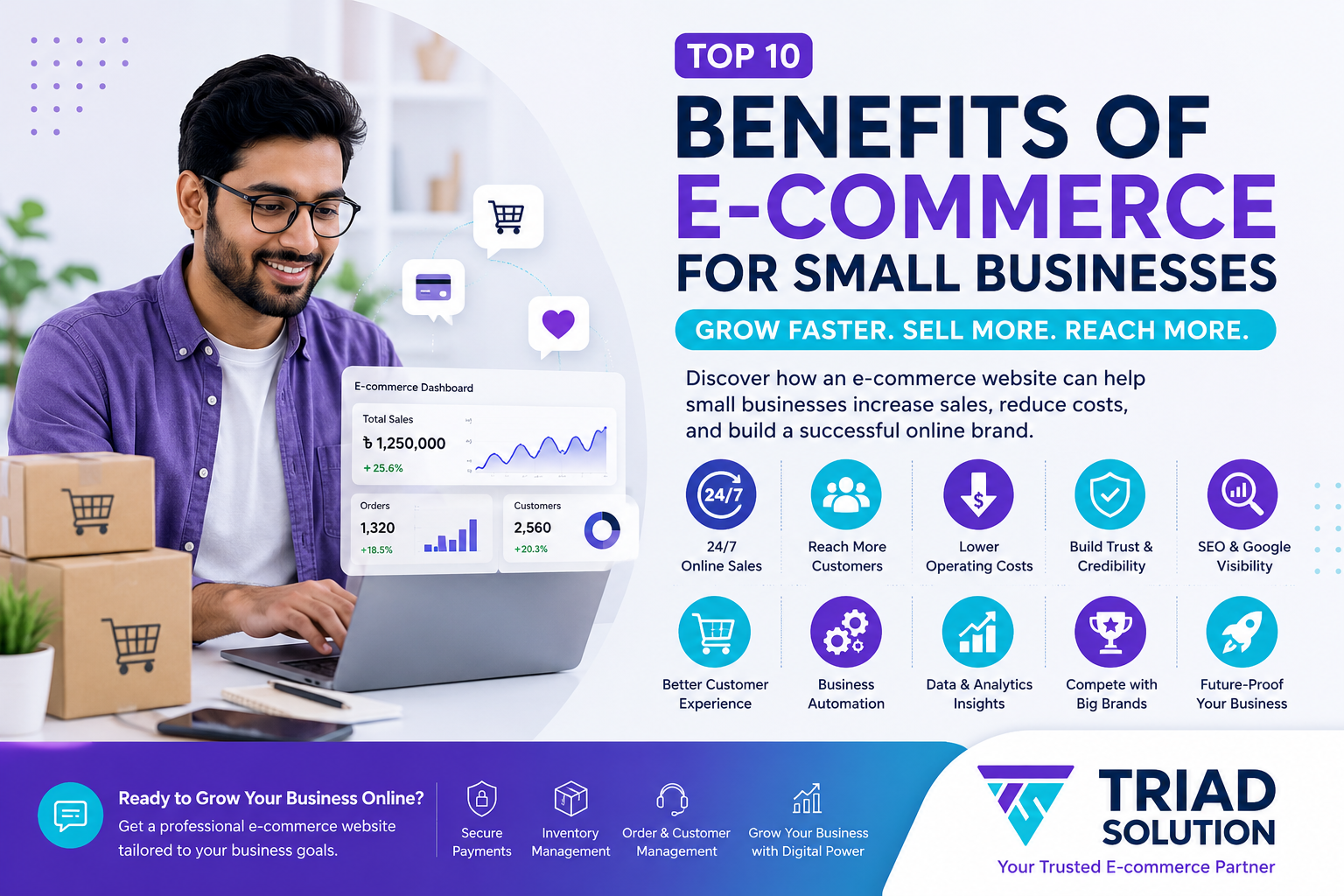
Top 10 Benefits of E-commerce for Small Businesses in 2026
Introduction
The way people buy products has changed forever.
A few years ago, customers visited physical stores to compare products, ask questions, and make purchases. Today, most buying journeys begin online. Customers search on Google, browse social media, compare prices, read reviews, and often make purchasing decisions before ever contacting a business.
This shift has created an incredible opportunity for small businesses.
Unlike traditional commerce, e-commerce allows even a newly established business to compete with larger companies by reaching customers online, providing a better shopping experience, and operating more efficiently.
Whether you own a fashion shop, electronics store, bakery, grocery business, cosmetics brand, pharmacy, furniture shop, or any other retail business, having an e-commerce website is no longer optional—it is becoming a necessity.
Businesses that adopt digital commerce early are better positioned to grow, while those that rely only on traditional selling methods risk falling behind.
In this article, we'll explore the ten biggest benefits of e-commerce for small businesses and explain why investing in an online store is one of the smartest business decisions you can make.
Why E-commerce Matters More Than Ever
Today's customers expect convenience.
They want to:
- Shop anytime
- Compare products quickly
- Pay securely
- Receive fast delivery
- Track orders online
If your business cannot meet these expectations, customers will likely choose a competitor that can.
An e-commerce website allows you to meet modern customer expectations while improving your business operations.
1. Your Business Never Closes
One of the greatest advantages of e-commerce is that your store remains open 24 hours a day, 7 days a week.
Unlike a physical shop, an online store does not depend on business hours.
Imagine someone searching for a product at midnight.
If your website is available, they can browse products, place an order, complete payment, and receive confirmation instantly—even while you are sleeping.
This means your business can generate sales every day without increasing working hours.
Business Impact
✔ Continuous sales opportunities
✔ Better customer convenience
✔ Increased revenue potential
2. Reach Customers Beyond Your Local Market
A traditional business usually serves customers within a limited geographical area.
An e-commerce website removes these limitations.
Instead of serving only your local community, you can sell products across:
- Your city
- Your district
- The entire country
- International markets
This expanded reach creates new revenue opportunities without opening additional branches.
For businesses in Bangladesh, this is especially valuable because digital payment systems and nationwide courier services have made online shopping easier than ever.
3. Lower Operating Costs
Opening additional physical stores requires significant investment.
Expenses include:
- Shop rent
- Electricity
- Furniture
- Employees
- Security
- Maintenance
An e-commerce website significantly reduces many of these costs.
Instead of investing in multiple physical locations, businesses can focus on improving products, marketing, and customer service.
Lower operating costs also allow businesses to offer more competitive prices.
4. Build Customer Trust and Brand Credibility
Modern consumers often judge a business by its online presence.
When customers find a professional website with detailed product information, customer reviews, secure payment options, and clear contact information, they are more likely to trust the brand.
A professional e-commerce website also reinforces your brand identity through consistent design, messaging, and customer experience.
This trust can lead to higher conversion rates and repeat purchases.
5. Increase Sales Through Google Search (SEO)
Unlike social media posts, which have a short lifespan, a well-optimized e-commerce website can continue attracting visitors from search engines for months or even years.
For example, if someone searches:
- Buy men's shoes online
- Best bakery in Dhaka
- Affordable office furniture
- Organic skincare products
A properly optimized website has the potential to appear in search results and bring in highly targeted visitors.
This means you can receive qualified traffic without paying for every click.
Over time, search engine optimization (SEO) becomes one of the most cost-effective marketing strategies for small businesses.
6. Improve Customer Experience
Today's customers value convenience above almost everything else.
They want to find products quickly, compare prices, pay securely, and receive updates about their orders without unnecessary delays.
A professionally developed e-commerce website makes this possible by offering:
- Fast product search
- Advanced product filters
- Mobile-friendly design
- Secure checkout
- Multiple payment options
- Order tracking
- Customer accounts
- Wishlist functionality
When customers enjoy a smooth shopping experience, they are more likely to return and recommend your business to others.
Example
Imagine two clothing stores.
The first asks customers to send product screenshots through Messenger and wait for a manual reply.
The second allows customers to browse products, select sizes, pay online, and receive automatic order updates.
Which business would most customers choose?
The answer is obvious.
Customer experience has become one of the biggest competitive advantages in modern commerce.
7. Automate Daily Business Operations
As your business grows, managing everything manually becomes increasingly difficult.
Many small business owners spend hours every day:
- Confirming orders
- Updating inventory
- Sending invoices
- Answering repetitive customer questions
- Following up with customers
These repetitive tasks consume valuable time.
With e-commerce automation, many of these activities happen automatically.
Examples include:
✔ Automatic order confirmation
✔ Invoice generation
✔ Inventory synchronization
✔ Shipping notifications
✔ Customer email updates
✔ Abandoned cart reminders
✔ Loyalty rewards
Automation reduces workload while improving speed and accuracy.
Instead of managing routine tasks, business owners can focus on marketing, customer relationships, and growth.
8. Access Valuable Business Data
One of the greatest advantages of selling online is access to real business insights.
Unlike traditional stores, an e-commerce platform records almost every customer interaction.
You can discover:
- Which products sell best
- Which products are rarely viewed
- Where customers come from
- Which marketing campaigns generate sales
- Average order value
- Customer purchase frequency
This information helps businesses make informed decisions rather than relying on guesswork.
For example, if analytics show that most visitors leave during checkout, you can simplify the checkout process and increase conversions.
Data-driven decisions help businesses grow faster and reduce unnecessary costs.
9. Compete with Larger Brands
Many entrepreneurs believe that only large companies can succeed online.
This is no longer true.
Today, customers care more about:
- Product quality
- Customer service
- Fast delivery
- Secure payments
- Easy shopping experience
A professionally designed e-commerce website enables small businesses to compete with national and even international brands.
With effective SEO, digital marketing, and automation, a local business can reach customers across the country without opening additional branches.
Technology has created opportunities that were almost impossible a decade ago.
10. Future-Proof Your Business
Technology continues to evolve rapidly.
Businesses that adopt digital tools today will adapt more easily to future innovations.
Modern e-commerce platforms can integrate with:
- AI Chatbots
- Customer Relationship Management (CRM)
- Marketing Automation
- Inventory Management Systems
- Accounting Software
- POS Systems
- Mobile Applications
Instead of rebuilding your business later, investing in the right e-commerce solution now creates a scalable foundation for long-term growth.
Future-ready businesses are better prepared to meet changing customer expectations.
Common Challenges Small Businesses Face Without E-commerce
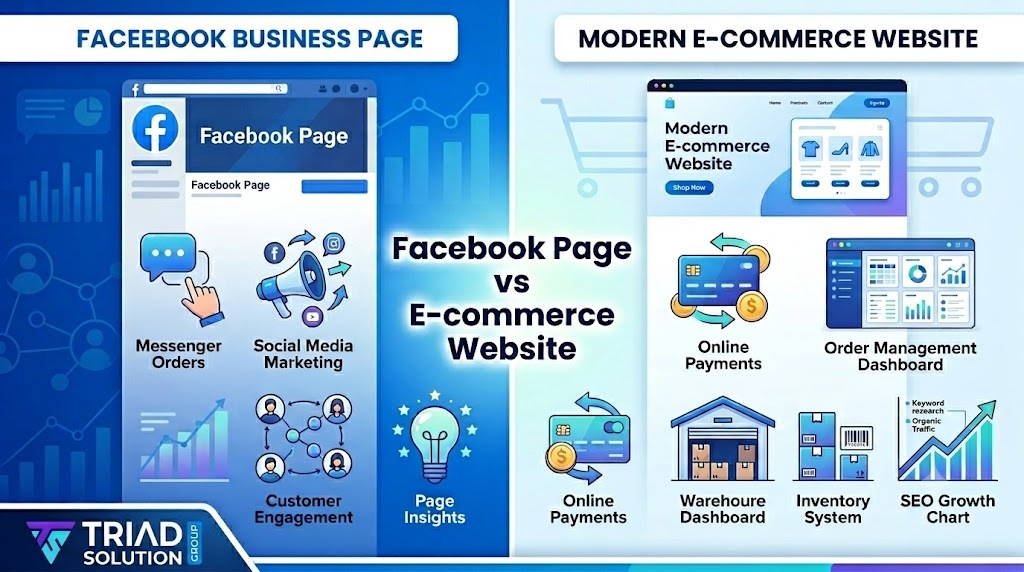
Many businesses still rely only on Facebook pages, WhatsApp, or physical stores.
While these channels are useful, depending on them alone creates several challenges.
Limited Business Hours
Customers can only purchase when someone is available to respond.
Manual Order Processing
Orders are collected manually, increasing the risk of errors and delays.
Poor Inventory Visibility
Without proper inventory management, businesses often oversell or run out of stock unexpectedly.
Limited Customer Data
Businesses miss valuable insights about customer behavior and purchasing patterns.
Dependence on Third-Party Platforms
Social media platforms frequently change algorithms and policies.
A business should never rely entirely on a platform it does not own.
An e-commerce website gives businesses greater control over their operations, customer data, and long-term growth.
Why Small Businesses in Bangladesh Should Invest Now
Bangladesh's digital economy is growing rapidly.
Consumers are increasingly comfortable with:
- Online shopping
- Mobile banking
- Digital wallets
- Home delivery services
This trend creates enormous opportunities for SMEs.
Businesses that establish their online presence today will be better positioned to serve tomorrow's customers.
Waiting too long may allow competitors to capture the market first.
How Triad Solution Helps Businesses Grow
At Triad Solution, we believe that an e-commerce website should be more than just an online catalog.
It should become the digital engine that powers business growth.
Our e-commerce solutions are designed to help businesses:
- Launch professional online stores
- Manage products efficiently
- Accept secure online payments
- Automate order processing
- Track inventory in real time
- Integrate POS and CRM systems
- Improve customer experience
- Scale confidently as the business grows
Whether you're starting your first online business or upgrading an existing store, choosing the right technology partner can make a significant difference.
The goal isn't simply to build a website—it's to create a platform that supports long-term business success.
Frequently Asked Questions (FAQ)
1. What is an e-commerce website?
An e-commerce website is an online platform where businesses can display products or services, accept orders, process online payments, and manage customers through a single digital system.
2. Is an e-commerce website suitable for small businesses?
Yes. An e-commerce website helps small businesses reach more customers, reduce operational costs, automate routine tasks, and compete with larger brands.
3. Can I sell only through Facebook instead of having a website?
You can start with Facebook, but relying only on social media limits your growth. A professional website gives you complete control over your business, improves credibility, and allows customers to find you through Google Search.
4. How much does it cost to build an e-commerce website?
The cost depends on your business requirements, features, payment gateways, integrations, and customization. Investing in a scalable solution often provides better long-term value than choosing the cheapest option.
5. Which businesses need an e-commerce website?
Almost every product-based business can benefit, including:
- Fashion & Clothing
- Electronics
- Grocery
- Pharmacy
- Bakery & Dessert Shops
- Restaurants
- Cosmetics
- Furniture
- Books & Stationery
- Pet Supplies
- Sports Equipment
6. Can an e-commerce website increase sales?
Yes. A professional website helps businesses attract customers through search engines, provide a better shopping experience, automate sales processes, and remain open 24/7.
7. Why is SEO important for an e-commerce website?
SEO improves your website's visibility on search engines like Google. Higher visibility means more qualified visitors, more leads, and more sales without relying only on paid advertising.
8. What features should every modern e-commerce website have?
A modern e-commerce website should include:
- Mobile-responsive design
- Secure online payments
- Inventory management
- Order management
- Customer accounts
- Product search and filters
- SEO optimization
- Analytics integration
- Marketing tools
- AI-ready architecture
People Also Ask (Google PAA)
These are excellent questions to include throughout the article:
- Is e-commerce profitable for small businesses?
- What are the advantages of selling online?
- Why should businesses invest in e-commerce?
- How does an online store help increase sales?
- Can a small business compete with big brands online?
- What is the future of e-commerce?
- Does every business need an e-commerce website?
- Which is better: Facebook Page or e-commerce website?